
Table of Contents
- Relapse Doesn’t Mean They Don’t Care
- When Outpatient Care Isn’t Enough
- What Residential Treatment Does Differently
- The Role of Time: Why 30 Days Makes a Difference
- Co-Occurring Conditions Need Unified Care
- It’s Not a Punishment. It’s a Pause That Heals.
- What If They Don’t Want to Go?
- For Families in Georgia, Hope Is Local
When your child relapses again, it doesn’t hit like the first time.
It hits heavier.
Because now there’s history. Maybe even multiple attempts—detox, therapy, outpatient treatment, support groups.
And for a moment, it looked like it might work.
Then it didn’t.
If you’re a parent watching your 20-something return to substance use, the heartbreak isn’t just about what’s happening now. It’s about how many times you’ve hoped, helped, and held on already.
But repeated relapse doesn’t mean your child is beyond help. It often means the kind of help they’ve received hasn’t gone deep enough—or lasted long enough—to truly support healing.
This is where a residential treatment program may be the next right step.
Not because your child is “failing.”
But because they need more than outpatient care can provide.
Relapse Doesn’t Mean They Don’t Care
When you see your child start using again after treatment, it’s easy to feel like everything you did—everything they did—was for nothing.
But relapse is rarely about apathy. It’s about vulnerability.
Young adults are often balancing unresolved trauma, mental health struggles, emotional immaturity, and peer pressure—all while trying to navigate early recovery without a fully developed brain. Add access to triggers, social isolation, or untreated co-occurring issues, and relapse becomes a high-risk outcome—not a personal failure.
A residential treatment program changes that equation by shifting the environment, increasing clinical oversight, and creating a pause long enough to build real internal stability.
When Outpatient Care Isn’t Enough
If your loved one has already tried outpatient therapy, IOP (intensive outpatient), or MAT (medication-assisted treatment), you might wonder: why didn’t it work?
The answer often isn’t about the quality of the care—it’s about the structure and intensity.
Outpatient treatment assumes the individual can manage:
- Living in a potentially triggering home or peer environment
- Self-regulating between sessions
- Taking medications as prescribed
- Showing up to appointments consistently
But if your child is relapsing repeatedly, those assumptions likely aren’t holding up. Not because they’re unwilling. Because they’re unwell.
Outpatient care gives moments of support.
Residential care gives an ecosystem.
What Residential Treatment Does Differently
Here’s what happens when someone enters a residential treatment program like the one offered at Southeast Detox:
- They’re removed from access and temptation. There’s no “one last use” after group therapy, no peer pressure from old friends, no immediate return to environments that encourage use.
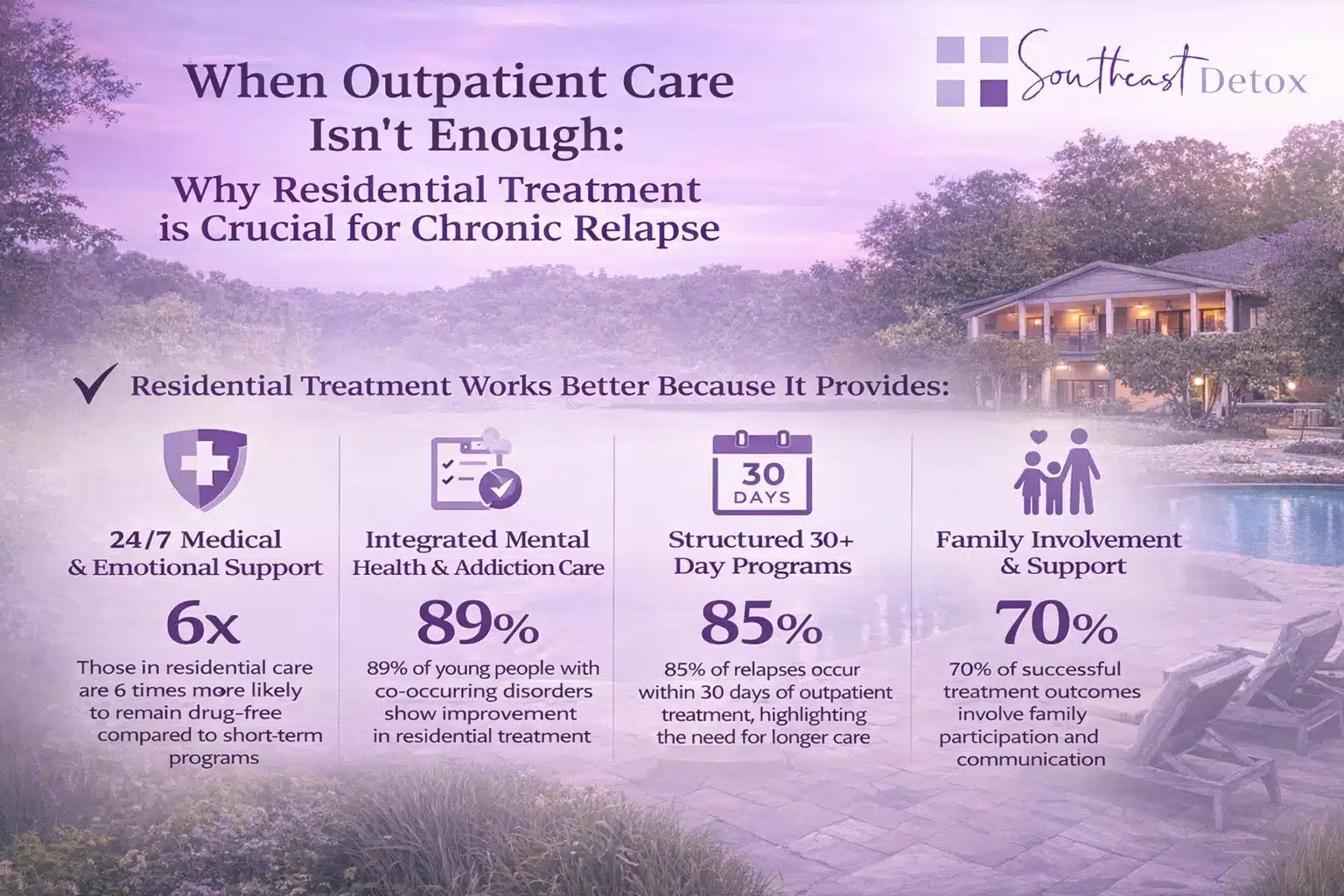
- They’re surrounded by 24/7 care. Medical, psychiatric, and emotional support is always available—day or night. It’s not just about safety. It’s about stability.
- They follow a structured, therapeutic daily schedule. Recovery becomes the full-time focus—not a side task squeezed between stressors.
- They build trust in a new routine. Over time, consistency leads to clarity. And that’s when deeper work begins.
This is where healing shifts from temporary to sustainable.
The Role of Time: Why 30 Days Makes a Difference
Repeated short-term interventions (like a 3–5 day detox or one week of IOP) often address crisis, not causation.
Real change takes time.
In residential treatment, your child has the space to:
- Detox safely if needed
- Stabilize their mood and sleep
- Begin trauma work without immediate outside pressure
- Relearn how to function emotionally without substances
- Rebuild coping skills that stick
The length of stay allows for layers of healing that outpatient care simply doesn’t have room for.
It’s not about keeping them away longer. It’s about giving them enough time to return whole.
Co-Occurring Conditions Need Unified Care
Many young adults using substances are also dealing with:
- Undiagnosed anxiety or depression
- ADHD or learning disorders
- PTSD or unresolved trauma
- Disordered eating, self-harm, or mood instability
Treating these separately from addiction can be ineffective—or even dangerous.
In residential care, these co-occurring issues are addressed simultaneously. Your child isn’t bouncing between therapists, doctors, and crisis calls. They’re receiving integrated treatment from a team that communicates and collaborates daily.
This isn’t just more efficient.
It’s safer.
It’s smarter.
And for many, it’s the first time their full story is seen and supported.
It’s Not a Punishment. It’s a Pause That Heals.
Parents often fear that sending their child to residential care will damage the relationship—or send the message that they’ve failed.
But that’s not how residential treatment is framed at Southeast Detox.
It’s not a penalty box.
It’s a protected space.
For young adults, that distinction matters.
They’re not “locked away.” They’re surrounded by a team that sees their pain clearly—and holds it responsibly. They learn. They rest. They rediscover their capacity for joy, honesty, and agency.
And as a parent, you get to breathe again. Not because it’s easy—but because it’s finally shared.
What If They Don’t Want to Go?
Many parents face resistance when residential care is introduced. That’s normal.
Here’s what we encourage:
- Don’t frame it as a threat. Frame it as a next step toward a better life they deserve.
- Acknowledge their fear. Let them name it without trying to “logic” them out of it.
- Remind them that time away is not time lost—it’s time finally used well.
Our admissions team can help you navigate those conversations. You’re not alone in this, either.
For Families in Georgia, Hope Is Local
If you’re searching for care in Metro Atlanta, Southeast Detox offers residential treatment that’s structured, compassionate, and designed specifically for people in repeated relapse.
We don’t shame your child.
We don’t blame your parenting.
We meet you both with clarity, calm, and commitment to change.
Our residential treatment program supports both clinical needs and emotional realities. Because recovery doesn’t begin with pressure—it begins with people who understand how hard it’s been, and how deeply you still hope.
Call 706-873-9955 to learn more about our medical detox program in Metro Atlanta, Georgia.