


I remember sitting in my car after my first attempt at getting help, staring at the steering wheel like it had answers.
I’d done what people said. I showed up. I listened. I tried.
And still, a few months later, I was right back where I started.
If you’ve been through something similar, you might be thinking: Why would this be any different?
That’s a fair question.
Let’s talk honestly about navigating Alcohol Addiction Treatment when the idea of long-term stability feels overwhelming—or even unrealistic.
When “Forever” Shuts Your Brain Down
The word forever is heavy.
Forever sober.
Forever changed.
Forever different.
For a lot of us, that’s the moment we disconnect. Not because we don’t care—but because our nervous system can’t hold something that big.
Long-term stability isn’t built by emotionally committing to the next 30 years.
It’s built by deciding what you’re doing this week.
If your last experience focused on permanence instead of process, it may have felt like being handed a life sentence instead of a path forward. And no one thrives under that kind of pressure.
You don’t need certainty about the rest of your life.
You need a plan for right now.
“It Didn’t Work” Might Mean It Didn’t Fit
Here’s something that gets oversimplified: not every treatment experience works the same way for every person.
Sometimes:
- The level of care wasn’t right.
- The environment didn’t feel safe.
- The group dynamic didn’t connect.
- Mental health issues weren’t fully addressed.
- Aftercare planning was too thin.
That’s not blame. That’s reality.
There’s a difference between round-the-clock support, structured daytime care, and multi-day weekly treatment. The intensity, accountability, and flexibility vary. If you felt overwhelmed last time, maybe it was too much too fast. If you felt like you were slipping through the cracks, maybe it wasn’t enough structure.
“Didn’t work” often means “wasn’t aligned.”
That’s an important distinction.
Stability Is Built With Support, Not Willpower
I used to believe the people who stayed sober were just stronger.
More disciplined.
More motivated.
More spiritually evolved.
That story kept me stuck.
Stability isn’t a personality trait. It’s infrastructure.
It’s having people who know when you’re off before you admit it.
It’s routine that catches you when your mood dips.
It’s accountability that feels steady—not shaming.
If you left your first attempt at Alcohol Addiction Treatment with a plan that relied mostly on your own determination, it makes sense that things unraveled.
White-knuckling looks strong from the outside. It’s exhausting on the inside.
You’re Allowed to Be Skeptical
This part matters.
If you feel disillusioned, I don’t want to talk you out of it. I want to understand it.
Maybe you felt talked at instead of listened to.
Maybe you were told to “just try harder.”
Maybe you followed the plan and still felt empty.
Skepticism doesn’t mean you don’t want change. It means you don’t want to be disappointed again.
There’s a big difference.
The right kind of program won’t require you to pretend you’re hopeful. It will meet you where you are—even if that place is tired, guarded, and cautious.
Long-Term Stability Is Quiet
No one posts about this part.
Stability isn’t dramatic. It’s subtle.
It’s:
- Going to bed without replaying the day in regret.
- Not hiding bank statements.
- Not planning your schedule around when you can drink.
- Not rehearsing lies in advance.
It’s quiet consistency.
And yes, it takes time. But it doesn’t require you to feel inspired every morning. It requires showing up imperfectly, repeatedly.
That’s less glamorous. It’s also more realistic.
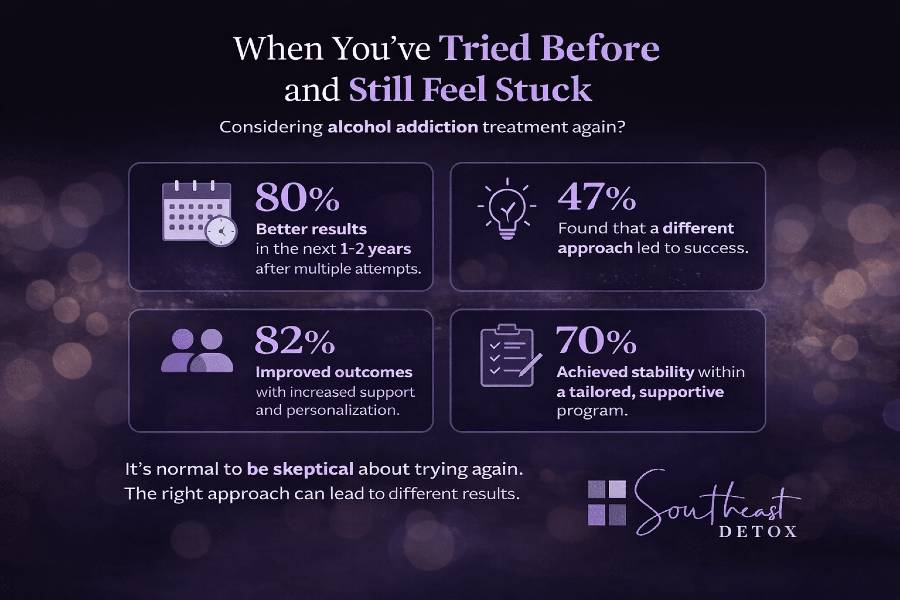
If You’re Considering Care in GEORGIA
If you’re looking at options and you live nearby, you might be exploring care in GEORGIA.
This time around, ask better questions:
- What does support look like after the main phase of treatment?
- How do you respond if someone struggles again?
- Is mental health treated alongside drinking?
- What does a typical week actually feel like?
- How do you measure progress besides “days sober”?
If a program can’t answer those directly, that’s useful information.
You deserve transparency. Especially if you’re thinking about re-entering Alcohol Addiction Treatment and want it to feel different than last time.
You Don’t Have to Feel Hopeful to Try Again
This might be the most important thing I can say.
You don’t need to believe it will work.
You don’t need to feel ready forever.
You don’t even need a big emotional breakthrough.
You just need to be honest about one thing:
Can I keep living exactly like this?
Sometimes the most grounded starting point is:
“I don’t know if this will help. But I know I can’t keep doing this.”
That’s enough.
What Changes the Second Time Around
When people come back to treatment—or start again after a setback—it often looks different.
They ask more questions.
They set clearer boundaries.
They participate differently.
They’re less concerned with impressing anyone.
There’s less performance.
And often, there’s more realism.
The second time isn’t about proving something. It’s about building something sustainable. That might mean a different structure. A slower pace. More focus on coping skills. More honest conversations about triggers and mental health.
It might also mean acknowledging that recovery isn’t linear.
That doesn’t make you broken. It makes you human.
Frequently Asked Questions
What if I already tried treatment and relapsed?
Relapse doesn’t erase the progress you made. It tells you something important: either more support was needed, something wasn’t fully addressed, or the transition afterward wasn’t strong enough. Going back isn’t starting from zero. You carry insight with you.
How do I know if I need more intensive support this time?
If you:
- Returned to drinking quickly after discharge
- Felt overwhelmed managing triggers alone
- Struggled with depression or anxiety alongside alcohol use
- Avoided support meetings or accountability
It may mean you need more structure or longer-term planning.
Different levels of care exist for a reason. The goal is to match intensity to your current reality—not to your pride.
What if I’m afraid of failing again?
That fear is common—and understandable. But avoiding treatment doesn’t protect you from failure. It just protects you from trying. The difference this time can be pacing, support, and honesty about what didn’t work before. Failure isn’t final. Inaction can be.
Can treatment work if I’m not fully convinced?
Yes. Plenty of people enter treatment skeptical. Motivation often grows after stability starts—not before. You don’t have to arrive inspired. You just have to arrive.
How long does it take to feel stable?
There isn’t a fixed timeline. Some people feel physical clarity within weeks. Emotional regulation can take longer. Building routines and rebuilding trust takes time. Stability is layered. It strengthens gradually. It’s not a light switch. It’s a dimmer that gets brighter with repetition.
What if I’m functioning fine on the outside?
Many people who seek Alcohol Addiction Treatment are working, parenting, and maintaining responsibilities.
Functioning doesn’t mean thriving.
If it’s taking increasing effort to hold everything together—or if drinking is your primary coping tool—that’s worth paying attention to.
You don’t have to crash to qualify for help.
You don’t have to promise forever.
You don’t have to feel inspired.
You don’t even have to be sure.
You just have to consider that your last experience doesn’t get the final word.
Call 888-981-8263 or visit our Alcohol Addiction Treatment services to learn more about our Alcohol Addiction Treatment services in Georgia.