


You’ve done this before.
You’ve found the program. You’ve helped them pack. You’ve hugged them goodbye with a mix of hope and fear. You’ve waited by your phone, checking for updates. You’ve prayed, bargained, cried, and convinced yourself, “Maybe this time it’ll work.”
And now it feels like you’re back at square one.
Your child—maybe 19, 22, 25—is using again. You’ve caught them lying again. You’ve seen the light leave their eyes again. And that ache in your chest? It’s part heartbreak, part helplessness, part how are we here again?
If you’re wondering whether it’s worth trying live-in care again, this blog is for you. Not to sell you on another stay. But to stand with you—in your grief, your fear, and your fierce, stubborn love.
At Southeast Detox, we’ve supported countless parents facing this same crossroads. Here’s what we want you to know if you’re facing it now.
Trying Again Doesn’t Mean You Got It Wrong
Let’s start with this: you didn’t fail.
You didn’t “miss something” the first time. You didn’t choose the wrong program. You didn’t do too much or not enough. And relapse—or continued use—is not a sign that everything was wasted.
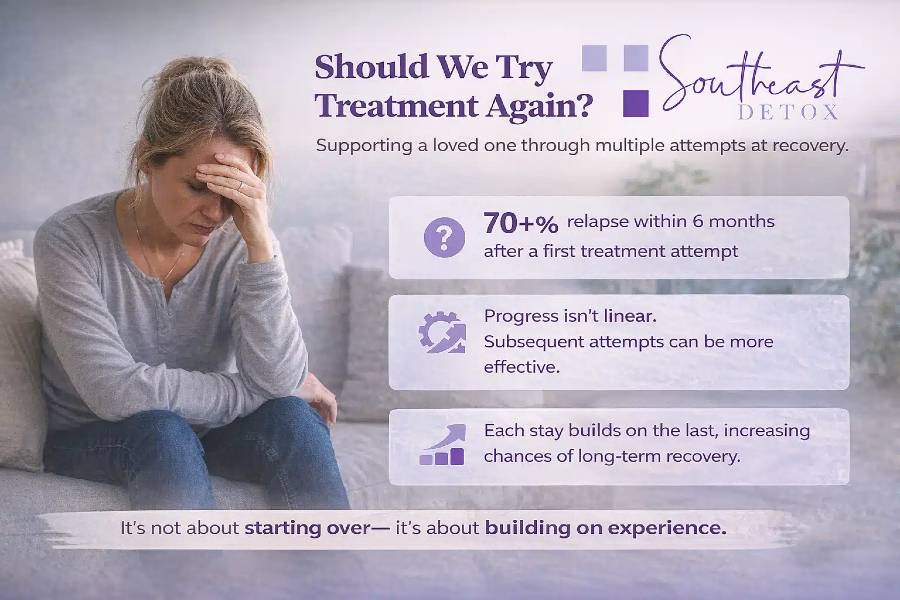
It’s a sign that your child is still struggling with something that doesn’t usually get solved in one round of care.
We’ve worked with clients who needed two, three, even five attempts before things finally clicked. Every stay planted something. Built something. Removed something.
Healing isn’t linear. But it is layered. And if your child didn’t stay sober, it doesn’t mean treatment didn’t work. It means there’s more work to do.
The Second (or Third) Time Can Be Different—Here’s Why
We hear this question often: “How do I know it won’t be just like last time?”
Here’s the honest answer: You don’t. But here’s what can make a real difference:
- Different timing. Maybe this time your child is more scared, more humbled, or more willing to reflect.
- More emotional clarity. Maybe the pain has finally become harder to ignore than the truth.
- A better clinical match. Not all programs are the same. Southeast Detox provides a unique combination of trauma-informed care and structured live-in support that meets clients where they are—not where we wish they were.
- Stronger family boundaries. You might be more grounded. More realistic. Less afraid to set terms and mean them.
Those shifts can make all the difference.
Sometimes, the treatment plan didn’t fail. The conditions around it just weren’t right yet.
Yes, You’re Allowed to Feel Tired and Still Try
Grief shows up in strange ways. Maybe you feel flat, exhausted, and emotionally numb. Maybe you’re angry—not just at your child, but at the system, at the broken promises, at yourself.
Maybe you’ve started asking hard questions like:
“Is this just who they are?”
“Am I enabling them by helping again?”
“What if this is hopeless?”
All of that is valid. Truly. This isn’t blind hope we’re talking about—it’s informed courage. The kind that knows exactly how hard it’s been and still says: If there’s another step to take, I’ll take it.
Trying again doesn’t mean you’re ignoring reality. It means you’re still grounded in love.
You Know More Now—And That’s Power
You’re not the same parent you were the first time around.
You’ve learned how to read between the lines. You’ve seen what manipulation looks like under stress. You’ve sat through the cycles. You know when they’re being honest and when they’re just trying to buy more time.
And that insight? That hard-earned clarity? It gives you an edge.
Now, you can set firmer boundaries. Now, you can ask sharper questions when you talk to the admissions team. Now, you can advocate for a longer stay, a better fit, a more trauma-aware approach.
You’re not naïve. You’re experienced. And experience makes you powerful.
Don’t Let Guilt Drive the Decision—Let Reality Guide It
One of the most painful things we see in parents is this gut-wrenching guilt:
- “I should’ve seen this coming.”
- “I should’ve intervened sooner.”
- “I should’ve been tougher/lighter/stricter/kinder.”
You’ve done the best you could with the information and tools you had. No one gives you a playbook for parenting a child with substance use struggles.
The only question that matters now is this: What’s true in this moment?
If your child is using again—lying again, isolating again, spiraling again—then the truth is that they’re still in crisis.
And they still need care.
They May Not Want to Go Back. That Doesn’t Mean They Shouldn’t.
Here’s something most parents learn eventually: waiting until your child is “100% ready” is a trap.
Some of our most successful long-term recovery stories started with resistance, resentment, or half-hearted commitment.
Because the truth is, readiness grows in the right environment. Not before it.
At Southeast Detox, we work with clients who are skeptical, shut down, or scared. We don’t need them to show up inspired. We just need them to show up—and stay.
From there, we do the heavy lifting of building trust, building insight, and helping them build something resembling motivation from the inside out.
Yes, You Can Do This Again—Without Losing Yourself
Boundaries are oxygen. Especially for parents who are running on emotional fumes.
If you’re doing this again, we urge you to set new terms. Not out of punishment—but out of survival.
You can say:
- “If you go into treatment, we’ll support you with housing when you’re out.”
- “If you leave against medical advice, we won’t cover a hotel or bail you out this time.”
- “We’ll be there at family therapy—but we won’t fight harder than you do.”
These aren’t cruel ultimatums. They’re compassionate limits. And they often help shift the dynamic from rescue to recovery.
You’re Still Allowed to Believe in Them
No matter how many times it’s fallen apart, you’re still allowed to hope.
Hope doesn’t mean ignoring the past. It means choosing to believe that healing is still possible—even when it takes more than one try.
Call 706-873-9955 or visit our live-in treatment services to learn how Southeast Detox helps families like yours navigate the hard return to care—with love, without shame, and with the tools you need this time around.
You’re not starting over. You’re starting from everything you’ve already survived. And we’ll be right here with you.