Alcohol Addiction
When You’re the One Everyone Relies On — But You’re Tired of Hiding Your Drinking

Written By

Alcohol Addiction
Written By
You’re the dependable one.
The one who answers emails at 10:47 p.m.
The one who signs the contracts.
The one who keeps the family steady.
And when the house finally goes quiet, you pour a drink that feels less like celebration and more like exhale.
I’ve sat across from surgeons, founders, attorneys, sales leaders, and stay-at-home parents who run households like operations centers. Many of them found our page on Alcohol Addiction Treatment not during a crisis—but during a quiet moment of honesty.
They weren’t falling apart.
They were tired of pretending they weren’t.
This is the part that keeps you stuck.
You still show up.
You still perform.
You still win.
So it’s easy to argue that the drinking isn’t a problem. After all, nothing has “blown up.”
But high-functioning drinking doesn’t mean harmless drinking. It often means hidden drinking.
I can’t tell you how many clients have said some version of:
The stereotype protects you—until it traps you.
Because when your life looks good on paper, it becomes harder to admit something underneath isn’t working.
High achievers are strategic thinkers. That doesn’t turn off at night.
You track your intake.
You measure how much is “acceptable.”
You calculate whether tomorrow’s meeting will suffer.
You promise yourself you’ll skip tonight.
Then you renegotiate.
It’s not the drinking alone that wears people down—it’s the constant internal negotiation.
That invisible mental tax is what brings many successful professionals into my office.
They’re not collapsing.
They’re depleted.
You might not relate to public stories of addiction. But see if any of this feels familiar:
These aren’t dramatic red flags.
They’re slow drips.
And slow drips still flood a room.
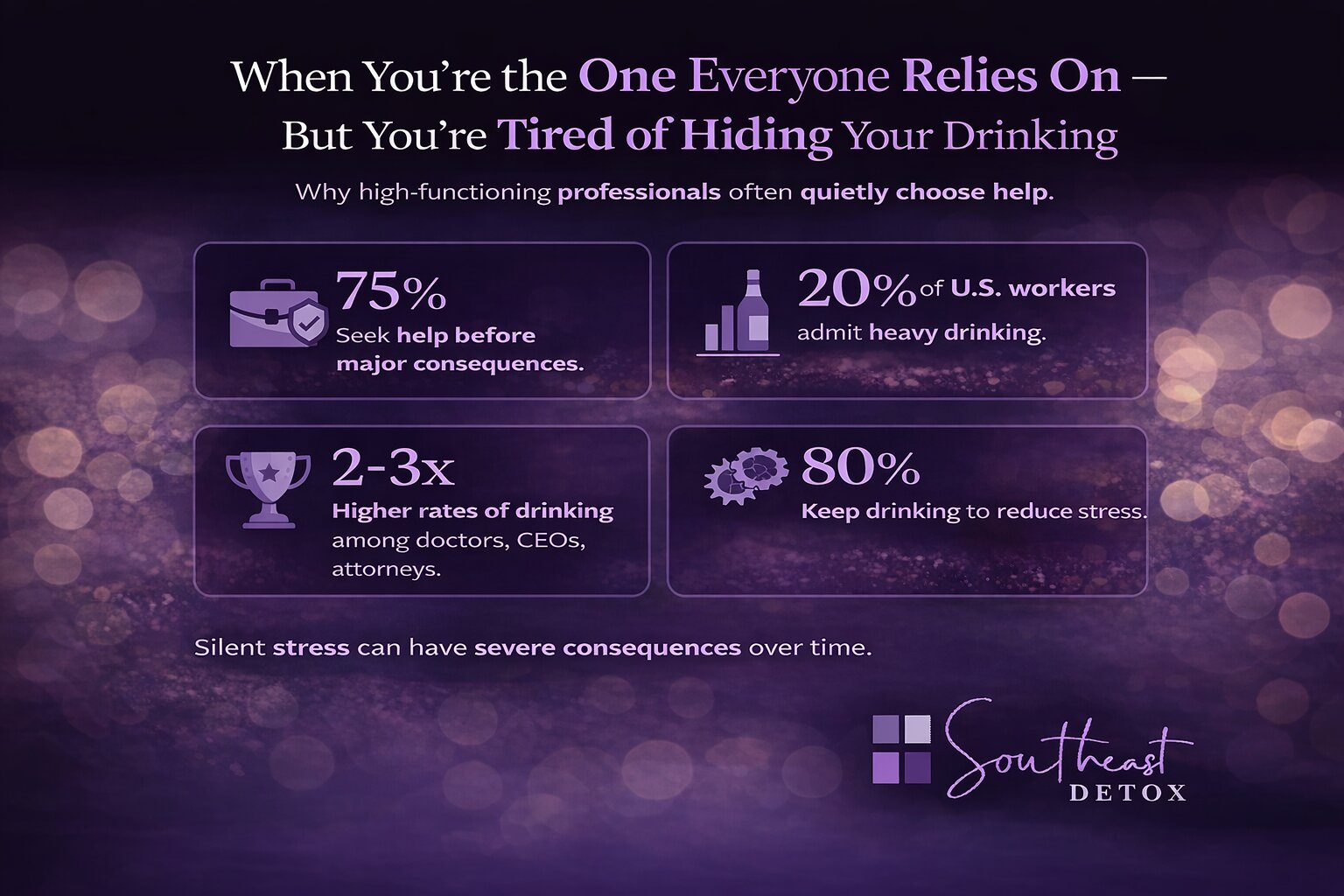
The professionals I work with understand one thing deeply: risk.
They insure their businesses.
They diversify investments.
They prepare contingency plans.
Eventually, they look at their drinking the same way.
Not as a moral failure.
As a liability.
Seeking support early isn’t dramatic. It’s strategic. It’s often done quietly, deliberately, and with the same thoughtfulness they bring to other major decisions.
Many explore structured daytime care or multi-day weekly treatment that allows them to continue working while addressing the patterns underneath. Others need short-term stabilization to reset physically and emotionally.
The goal isn’t to punish ambition.
It’s to protect it.
Here’s what people rarely say out loud:
“If I stop drinking… who am I at networking events?”
“What happens to my edge?”
“Will I lose the version of me that people like?”
For high performers, alcohol can feel like:
Letting that go can feel threatening—not because you love alcohol, but because you’ve attached it to competence.
I’ve watched clients discover something powerful:
The clarity they feared losing was actually waiting underneath.
You don’t lose your drive.
You lose the fog.
In the Southeast, reputation matters. Community ties run deep. Professional circles overlap.
That’s why discretion isn’t optional—it’s essential.
If you’re considering support in Georgia, it’s reasonable to ask about confidentiality, scheduling flexibility, and how care fits into your life—not the other way around.
Treatment does not have to mean public disruption. It can mean:
Quiet decisions often create the most profound shifts.
The most consistent feedback I hear from high-functioning clients after engaging in Alcohol Addiction Treatment is not about catastrophe avoided.
It’s about relief.
Relief from:
There’s a particular kind of freedom that comes from not managing two lives.
You get your full cognitive bandwidth back.
And for high performers, that’s everything.
This question comes up constantly.
Here’s my clinical answer:
If you’re researching treatment privately at midnight, something in you already knows it’s worth exploring.
You don’t need to meet a catastrophic threshold to deserve support.
Early intervention is easier than damage control.
And seeking help before consequences escalate is not dramatic—it’s intelligent.
No. In fact, most high-functioning professionals don’t.
Rock bottom is not a requirement. It’s simply what happens when someone waits too long. Many successful individuals seek help while their careers and relationships are intact because they want to keep them that way.
In many cases, yes.
Depending on your needs, there are options that allow you to maintain work responsibilities while engaging in structured support several days per week. The goal is to integrate recovery into your real life—not isolate you from it unless medically necessary.
Confidentiality is protected under federal law. Treatment records are not public, and professional licensing boards do not automatically receive notification simply because someone seeks care. If you have specific career concerns, those can be discussed directly and transparently.
Ambivalence is normal.
You don’t have to commit to a lifetime declaration before starting a conversation. Many people begin by simply assessing their relationship with alcohol and exploring whether change would improve their quality of life.
Clarity often comes after you create space—not before.
Ask yourself:
Severity isn’t always measured by public damage. It’s often measured by private strain.
It begins with a conversation.
Not a commitment. Not a contract.
A conversation about what’s been happening, what’s worrying you, and what level of care makes sense. Assessment comes before recommendation. Collaboration comes before decisions.
You stay informed.
You stay in control.
Most high-functioning clients don’t announce their choice to get help.
They research.
They reflect.
They reach out privately.
And then they begin.
Not because they failed.
Because they’re done carrying it alone.
If you’re reading this and something in you feels seen, that matters.
Call 888-981-8263 or visit our page to learn more about our Alcohol Addiction Treatment services in Georgia.