Residential Treatment
If You Think a Residential Treatment Program Didn’t Work, You’re Not Alone — Here’s What Helped Me Reconsider

Written By

Residential Treatment
Written By
I used to think I was the kind of person that treatment didn’t work for. I wasn’t defiant. I wasn’t unwilling. I showed up, followed the rules, sat through group. And yet… nothing stuck.
What no one told me then—and what I now say to you—is this: If you walked away from a residential treatment program feeling unchanged or worse, that doesn’t mean you failed. It doesn’t mean you’re beyond help. It means you’re human—and that something about the process didn’t fit what you needed.
If you’re in or around Atlanta, and wondering if you should even consider going back, Southeast Detox offers residential treatment that feels different for a reason. And that difference mattered more than I ever expected.
I’ll never forget that feeling of walking out the doors after my first stint in residential treatment. Everyone around me was clapping, congratulating me for “finishing strong.” But inside, I felt numb. Not proud. Not hopeful. Just… flat.
I remember the sunlight hitting my face like a spotlight, like I was supposed to step into some new chapter. But the truth was, I didn’t feel changed. I felt like I had learned how to act the part, say the right things, and keep my head down until discharge. And maybe that’s what got me through it—but it didn’t get me free.
There’s a specific kind of heartbreak that comes when you finally ask for help… and it doesn’t help. When you do the scary thing—go to treatment, leave your life behind, get vulnerable—and walk away still feeling lost.
That’s not just disappointment. That’s grief. And if you’re sitting with that grief, please know: you’re not alone. And you’re not wrong for feeling it.
It took me a long time to realize that my experience wasn’t rare—it just wasn’t talked about enough. Here are a few things I wish I’d understood back then:
Some residential programs are highly structured, with rigid schedules and one-size-fits-all programming. That works for some people. But if you’re someone who needs deeper emotional connection, trauma-sensitive care, or more individualized therapy, that kind of structure can feel more like a shell than a solution.
I could talk about my “issues” all day. I’d been doing that for years. What I needed was a space that helped me feel again—safely. Not just perform recovery, but actually start it. That requires a certain kind of staff, culture, and patience that not every facility prioritizes.
I expected to feel better when I left. But in reality, leaving is when the work really begins. If your discharge plan didn’t set you up with support, or if you felt pushed out instead of prepared, that’s not your fault. That’s a system failure—not a personal one.
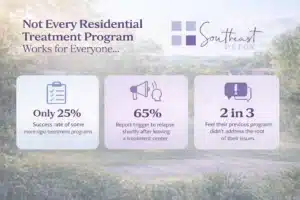
After that first experience, I swore I’d never go back. I even laughed when someone suggested I “give treatment another shot.” But something shifted when I stopped looking for a program that promised to change my life—and started looking for one that felt honest.
Here’s what helped me try again:
When I finally stepped into a program that felt like the right fit, everything slowed down. I didn’t have to act like I was ready. I didn’t have to hide my anger, my confusion, or the fact that I didn’t really believe it would work.
Instead of being told to “trust the process,” I was invited to participate in shaping it. My treatment plan wasn’t a photocopied checklist. It was a conversation. One I was part of.
I wasn’t fixed overnight. But for the first time, I wasn’t just surviving treatment—I was being seen inside it.
If you’ve been through a residential treatment program and left feeling like you failed—or worse, like it failed you—you’re not the only one. And you’re not being dramatic or ungrateful. You’re being honest.
And honesty like that deserves another shot. A real one.
If you’re anywhere near Atlanta and want to explore a program that actually hears that part of you, Southeast Detox isn’t afraid of your doubt. They’ve built their residential program to hold people just like us.
Trying again isn’t weakness. It’s wisdom. You’re not starting from scratch—you’re starting from experience. You know more about yourself, more about what you need, more about what didn’t work last time.
That kind of knowledge is gold in the right hands. And the right program won’t waste it.
The biggest difference often comes down to personalization. A high-quality program will take time to understand your background, your goals, your past experiences, and your hesitations. Look for centers that offer trauma-informed care, flexible programming, and real-time feedback loops—not just canned lectures and routines.
Yes. Completely. And a good program won’t try to talk you out of your skepticism—they’ll respect it. If a facility can’t handle your honesty, it’s probably not the right one.
Ask:
Start by just calling. There’s no pressure. You’ll know quickly whether the person on the other end is just reading a script—or actually wants to know what you need.
Southeast Detox is designed to support adults who are skeptical, hurt, and looking for something real. And real starts with how you’re treated from the very first conversation.
That’s okay. You don’t have to believe right now. You just have to stay open long enough to see if something feels different. And if it doesn’t? That’s information too. But you deserve to have all the information before giving up completely.
Still feeling unsure—but curious enough to ask a question?
Call 706-873-9955 to learn more about our residential treatment program in Atlanta, GA. No pressure. No expectations. Just a conversation that meets you where you are.