Residential Treatment
The Myth of the ‘Not Sick Enough’ Addict: What We See in Residential Treatment Every Day

Written By

Residential Treatment
Written By
There’s a sentence we hear almost every day at Southeast Detox:
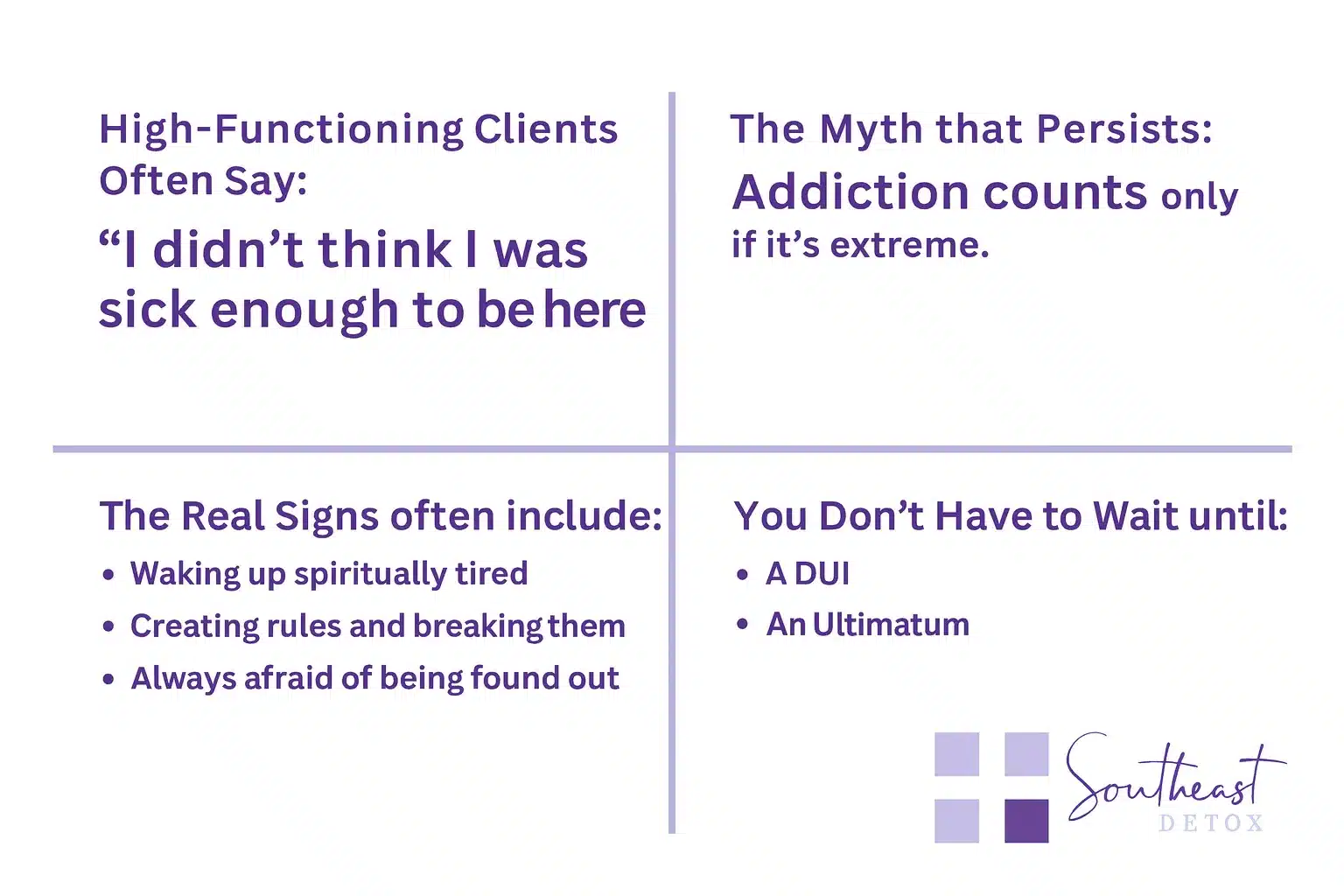
“I didn’t think I was sick enough to be here.”
It comes in different forms. Sometimes it’s half a joke—nervous laughter, eyes scanning the room for someone who looks more like they belong. Other times, it’s a confession, whispered in shame: “I haven’t lost my job. I haven’t crashed my car. I haven’t hit bottom.”
But the pain is real. The fear is real. And the truth is—you don’t have to be falling apart on the outside to be drowning on the inside.
We work with high-functioning people every single day. People who are exhausted from holding it together. People who live in fear of being found out. People who wonder if they’re living someone else’s life—because theirs got too painful to stay in.
There’s a persistent lie in our culture: that addiction only counts if it’s extreme.
You know the version. Homeless. Unemployed. Legal issues. Family estrangement. Rock bottom.
But here’s what that myth does: it keeps people quiet. It keeps them sick.
Because if your life still looks okay on paper, you start believing that what you feel doesn’t matter.
We see this all the time in our residential treatment program. Clients who never missed a shift. Who still made school pickups. Who kept their calendar full, their social feeds curated—and their secrets buried.
Addiction in high-functioning individuals isn’t always dramatic. It’s quiet. It’s subtle. It blends in with ambition, people-pleasing, and perfectionism.
You might relate if:
We’re not here to tell you what your problem is. But we are here to say: if it hurts, it matters. And you don’t need to earn your suffering.
Let me tell you about the people we work with—not by name, but by truth.
We’ve cared for a senior marketing executive who drank three glasses of wine nightly “to wind down” and popped Adderall to stay sharp.
We’ve supported a stay-at-home parent who managed three kids, a calendar full of activities, and a growing dependency on prescription pills she couldn’t tell her partner about.
We’ve helped a college athlete who was celebrated for his discipline—while secretly binging alone in his dorm and hating himself the next morning.
All of them walked in thinking they were the exception. That they didn’t really belong here.
All of them walked out clearer, lighter, and—for the first time in years—honest.
So what actually happens in a residential setting like Southeast Detox?
It’s not a punishment. It’s not a break from real life. It’s a reset.
Here’s what we offer:
Most importantly, we give you space to stop surviving and start feeling. Not every second of every day—just enough to start trusting that peace is possible.
One of the most dangerous things about being high-functioning is how easy it is to rationalize.
“I haven’t lost anything.”
“I’m still managing.”
“It’s not that bad.”
But functioning isn’t the same as thriving. And if you’re reading this, something inside you is already questioning whether the life you’re living is really yours.
You don’t need a DUI, a medical emergency, or an ultimatum to get help.
You just need a moment of honesty—and the willingness to act on it.
Some people worry they’ll get “trapped” in treatment, or that going to residential means their life will never look normal again.
The opposite is often true.
By the time clients complete our residential program, they’re more grounded, more connected to themselves, and often more capable of rebuilding the life they actually want—not the one they were white-knuckling through.
Our team builds a customized discharge plan that may include:
This isn’t the end of your story. It’s a turning point.
We tell our clients this all the time: Coming here doesn’t mean you’re weak. It means you’re strong enough to stop pretending.
You’ve already done the hard thing—carrying the weight alone, hiding in plain sight, trying to out-think a brain that’s slowly been turning against you.
Now, you get to do something different.
Something brave.
Something for you.
We’re not here to shame you or fix you. We’re here to meet you at the point where tired meets ready.
And if you’re ready? We’re here.
Our residential treatment program in Atlanta is uniquely equipped for high-functioning adults who want care that’s smart, private, and deeply respectful.
Here’s what sets us apart:
You can keep managing. Or you can start healing.
You get to choose.
You don’t need a label to get help. If your substance use is affecting your peace, performance, or relationships, it’s worth exploring.
Our team works with you to develop realistic plans for leave, and we can provide letters or coordination when needed. This is an investment in your ability to show up fully in the rest of your life.
You might be surprised how much you have in common. Our clients come from all walks of life, but many share similar emotional patterns: shame, fear, exhaustion, perfectionism, secrecy.
Typical stays range from 14 to 30 days, depending on your needs and progress. Every treatment plan is personalized.
We protect your privacy. Admissions, participation, and discharge are all handled confidentially. You don’t have to explain yourself to anyone you don’t choose to.
Call 706-873-9955 or visit Southeast Detox’s residential program page to talk with someone who understands.
If you’re tired of pretending everything’s fine, you don’t have to anymore. Help is ready when you are.