


You’ve probably had the thought already.
Maybe I should just stop.
No appointments. No explaining anything to anyone. Just quit and push through it.
For many people considering recovery for the first time, that idea feels appealing. It sounds simple, strong, even responsible. Just stop using and deal with whatever comes next.
And wanting to quit on your own often comes from a good place. It means something inside you is ready for change.
But what many people don’t realize is that withdrawal from certain substances can be unpredictable—and sometimes dangerous—without the right support. That’s why many people begin recovery with medically supported care like the one described in our supervised detox support.
If you’re feeling nervous about that step, you’re not alone. Many people who come through our doors once tried to quit by themselves first.
And their stories often begin the same way.
The Quiet Moment When Someone Decides to Quit
The decision to stop using rarely arrives in a dramatic moment.
More often, it comes quietly.
You wake up one morning feeling worse than usual. Your body feels heavy. Your mind feels tired. You start thinking about how long this has been going on.
Maybe someone you care about says something that sticks with you.
Maybe you look at yourself in the mirror and feel a wave of honesty you’ve been avoiding.
Or maybe it’s simply exhaustion.
The moment you realize something needs to change can feel both powerful and terrifying.
Because once the thought appears—I should stop—the next question shows up quickly:
Can I actually do this?
Many people decide the answer is yes, and they attempt to quit immediately.
But the body often has its own response to that decision.
Why the Body Reacts So Strongly to Withdrawal
Over time, the body adapts to repeated substance use.
It adjusts brain chemistry, stress hormones, sleep cycles, and even heart function to maintain balance while substances are present.
This process is called physical dependence.
When substances suddenly disappear, the body doesn’t immediately know how to rebalance itself.
Instead, it reacts strongly.
The nervous system becomes overactive. Stress signals increase. Brain chemistry shifts rapidly.
For some people this leads to uncomfortable but manageable symptoms.
For others, the reaction can become intense.
Withdrawal symptoms can include:
- Severe anxiety or panic
- Sweating and shaking
- Nausea or vomiting
- Rapid heart rate
- High blood pressure
- Severe insomnia
- Confusion or hallucinations
- Seizures in some cases
These reactions aren’t signs of weakness.
They’re signs that the body has become used to functioning with certain substances in its system.
And when those substances disappear suddenly, the body struggles to stabilize itself.
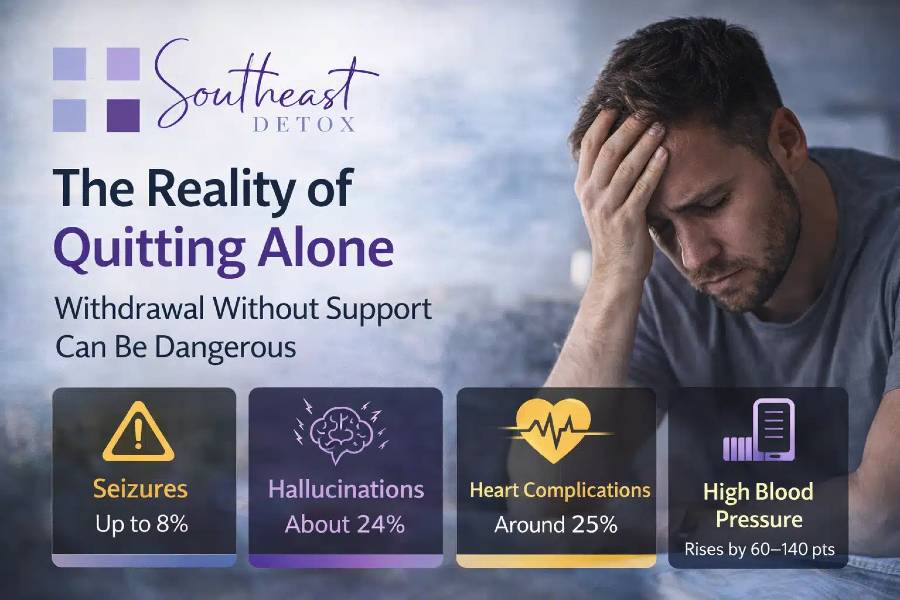
Why Quitting Alone Can Become Dangerous
For some substances, withdrawal is not just uncomfortable—it can be medically risky.
Alcohol, benzodiazepines, and certain other drugs can cause withdrawal symptoms that escalate quickly without medical monitoring.
The body may experience extreme stress as it attempts to rebalance brain activity.
In rare but serious cases, this can lead to seizures, heart complications, or dangerous changes in blood pressure.
This is why medical professionals strongly discourage quitting suddenly without support when physical dependence is present.
The goal of professional care during withdrawal is not simply to stop substance use.
It’s to keep the body safe while it resets.
That difference matters.
The Fear That Stops People From Reaching Out
Even when people suspect withdrawal could be difficult, many still try to push through it alone.
Fear often plays a big role in that decision.
Some people worry about being judged.
Others worry about what treatment will be like. Will it feel restrictive? Will it disrupt their life too much?
And many people carry a quiet belief that they should be able to handle the problem themselves.
But recovery isn’t about proving strength through suffering.
It’s about creating the safest possible conditions for change.
Asking for help doesn’t mean you failed.
It means you’re giving yourself the best chance to succeed.
What Support Looks Like During Detox
When people begin supervised detox, the experience is often very different from what they expected.
Instead of being left alone with intense symptoms, they’re supported by professionals who understand exactly what the body is going through.
Medical teams monitor vital signs, hydration, and overall stability.
Comfort-focused care helps reduce the severity of symptoms.
People are encouraged to rest, hydrate, and allow the body time to adjust.
But the support is not just physical.
Many people entering detox feel anxious, overwhelmed, or uncertain about the future.
Having compassionate professionals nearby helps reduce that emotional pressure.
You’re not navigating the hardest stage alone.
You’re supported through it.
Stories of People Who Tried to Quit Alone First
Many of the people who come to detox share a similar experience.
They tried to quit on their own first.
Some lasted a day or two before withdrawal symptoms became overwhelming.
Others made it through the initial symptoms but returned to using because the physical and emotional discomfort felt unbearable.
One person once described it like this:
“It felt like my body was screaming for something I didn’t want to give it.”
That internal battle can be incredibly difficult to manage alone.
But when the same person later went through detox with medical support, the experience changed dramatically.
They were able to rest. Symptoms were monitored. The pressure to “tough it out” disappeared.
Instead of feeling like they were fighting their own body, they finally felt supported through the process.
What Happens After the Body Begins to Stabilize
Something remarkable often happens once withdrawal symptoms begin to fade.
Clarity returns.
Sleep improves.
The constant cycle of substance use and withdrawal begins to slow down.
People start noticing small changes they haven’t experienced in a long time.
Food tastes better. Energy slowly increases. Moods stabilize.
And many people begin to realize something surprising:
They’re not as broken as they thought.
Their brain and body simply needed time to recover from the constant chemical stress substances were creating.
That realization can bring hope.
Recovery begins to feel possible again.
The First Step Doesn’t Have to Be Perfect
For many people considering treatment for the first time, the idea of detox feels intimidating.
But detox isn’t about having everything figured out.
It’s about taking one step toward stability.
It’s about giving your body the space it needs to reset.
And for many people, it’s the first moment in a long time when life begins to slow down instead of spinning out of control.
For individuals searching for help in Metro Atlanta, having supportive care during withdrawal can make the beginning of recovery feel far less overwhelming.
You don’t have to be completely confident.
You just have to be willing to start.
You Don’t Have to Face Withdrawal Alone
Trying to quit on your own often comes from determination.
You want your life back. You want control again. You want things to feel normal.
But sometimes the safest way forward is allowing someone to help you through the hardest part.
Many people who begin detox say the same thing afterward.
They wish they had done it sooner.
You deserve support while your body heals and resets.
Call 706-873-9955 to learn more about our Medical Detox Program in Metro Atlanta, Georgia.