


It’s been years since I walked out of that place.
And I still think about it.
Not every day. But in moments when things feel flat. Or when I’m doing everything right—service, meetings, journaling—and still feel like something’s missing.
I don’t think about my first chip. Or my first big “aha” in therapy. Or the day I made amends to my mom.
I think about detox.
The beige walls. The sterile smell. The nurse who didn’t flinch when I told her I didn’t think I could do this. The hallway I paced like a caged animal. The moment I stopped shaking.
It wasn’t beautiful. It wasn’t inspiring.
But it was the first time I let someone keep me safe—without needing me to be anything but willing to stay.
And that moment? Still ripples through me now.
I Didn’t Feel Grateful Then. I Barely Felt Human.
Let’s be clear: I didn’t walk into detox with hope in my heart.
I was wrecked. Skeptical. Sick. Mostly there because people were threatening to give up on me if I didn’t “do something.”
So I did something.
I called Southeast Detox.
I don’t remember what I said on the phone. Probably something like, “Yeah, I guess I need to come in.” What I do remember is how fast they moved. No lecture. No pressure. Just, “Let’s get you here safely.”
When I arrived, I could barely hold a cup without my hands trembling. I kept thinking, This is so stupid. I don’t even want this.
But I stayed. And they stayed with me.
That mattered more than I knew.
Detox Didn’t Give Me Clarity. It Gave Me a Breather.
Back then, I thought detox would either fix me or fail me.
I had no in-between setting.
If I didn’t feel “changed” by the end of the week, I figured it meant recovery wasn’t for me. I didn’t understand that detox wasn’t supposed to give me answers.
It was supposed to interrupt the spiral.
That’s it. And that’s everything.
What that medical detox program gave me was a pause. A place where I could stop falling long enough to consider—just consider—that maybe I didn’t want to die like this.
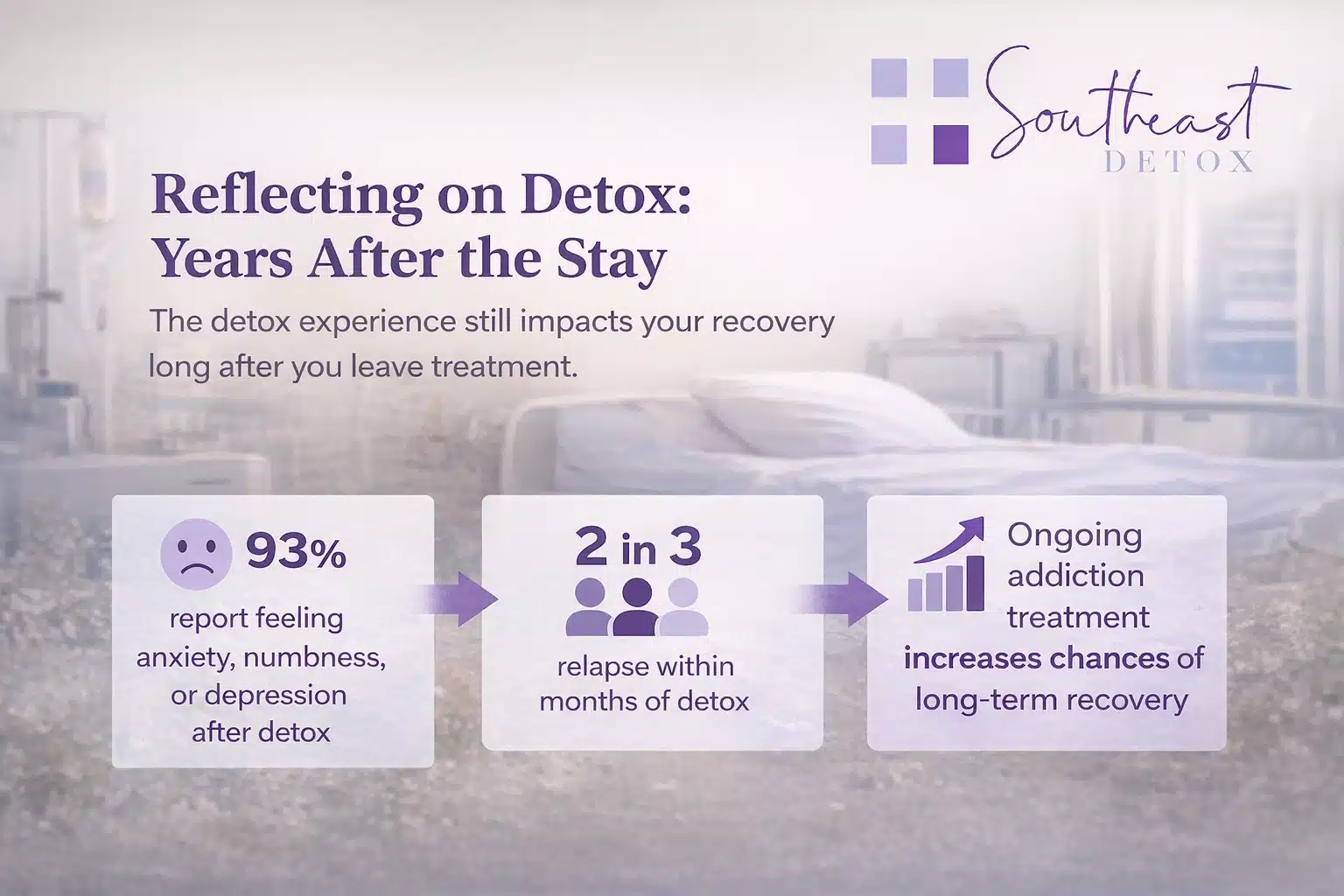
Years Later, I Still Feel the Impact of That Pause
It’s hard to explain to people who haven’t been there, but something about those first few days sticks.
The sensation of being clean for the first time in years. The awkward stillness when the craving fades and nothing takes its place. The weird, almost painful quiet in your own head.
Sometimes I forget how bad things were before detox. The way my body ached for a fix before I even opened my eyes in the morning. The way my brain couldn’t form a full thought without chasing it into self-destruction.
But then I remember that room. That nurse. That 3am moment when someone brought me ginger ale because I couldn’t keep anything else down.
It wasn’t a big deal to them. It was everything to me.
Sobriety Got Stable—Then It Got Strange
If you’re years into recovery, you probably know this feeling.
You’ve done the work. You’ve rebuilt your life. People trust you again. Your calendar is full. You hit milestones. You speak at meetings. You mentor others.
And then… something shifts.
You feel weirdly hollow. Not like you want to use—but like something essential went missing.
That’s what hit me last year. A slow, low-grade ache I couldn’t name. I wasn’t in danger of relapsing. I just didn’t feel connected anymore.
And oddly, I found myself thinking about detox again. The rawness. The urgency. The clarity that came from being so stripped down I had no choice but to be real.
I missed that.
Not the pain. Not the chaos. But the honesty.
Detox Showed Me Who I Was Without the Noise
There’s something wild about being at rock bottom in a safe place.
It’s one thing to unravel in public, on a bender, in front of people who just want you to stop.
It’s another thing entirely to fall apart in a room where no one flinches. Where your worst isn’t shocking. Where you’re allowed to be completely undone and still worth caring for.
That’s what Southeast Detox gave me.
And it’s why I still think about it.
It was the first place that didn’t need me to perform. Didn’t ask me to prove I deserved help. Just handed me a blanket and said, “You’re not alone.”
The Memory of Detox Keeps Me Humble—and Grateful
Long-term recovery comes with a strange kind of amnesia. You forget how bad it was. How close you were to giving up.
That’s why I revisit the memory of detox—not to punish myself, but to remember.
To remember the cost of getting here.
To remember that I didn’t do this alone.
And to remind myself that when I feel spiritually dry, emotionally tired, or disconnected from the work—I have a place I can trace it back to. A beginning I didn’t recognize as sacred until years later.
If You’re Feeling Disconnected, You’re Not Alone
It doesn’t mean you’re ungrateful. It doesn’t mean you’re broken.
It means you’ve lived through enough silence to notice the gaps.
But if the gaps start to feel like cracks—if the “blah” turns into something heavier—you don’t have to pretend it’s fine. You don’t have to fake gratitude. You don’t have to hide your confusion.
You’re allowed to seek reconnection. Even years in.
And sometimes that reconnection begins where the whole thing started. With a reminder that detox isn’t just a medical process. It’s a human one.
If you’re looking for care in Metro Atlanta that still honors that truth, Southeast Detox gets it.
They were there when I was barely hanging on.
And they’re still there now.
When You’re Ready to Feel Real Again
You don’t need to fake peace. You don’t need to pretend the fire never goes out.
You just need one real place that remembers your beginning.
Call 706-873-9955 or explore our medical detox program in Georgia to learn more about how Southeast Detox supports your whole recovery—whether you’re on day one or year ten.
You’re not alone. And you never were.